If your toilet hums when nobody has used it for hours, the tank is probably refilling itself. Water slips out, most likely past a worn flapper, and the fill valve vibrates each time it opens to top the tank back up. It keeps going until you fix it, so it shows up on your water bill.
Here’s how to find it and fix it, step by step.
Step 1: Understand Why Your Toilet Is Humming
That hum you hear? It’s usually the fill valve vibrating as water continuously flows or attempts to refill the tank due to a slow leak.
The most common causes:
- A worn-out fill valve
- A deteriorated flapper
- Improperly adjusted float levels
Any of these can trigger the fill valve to engage sporadically or even constantly. That’s what creates the hum, and to stop toilet noise, you need to get to the root of it. If the hum only comes right after a flush, while the tank refills, first read why a toilet hums after flushing.
Step 2: Use Water Leak Detection (Manual or Automatic)
Before taking things apart, detect the leak. You can go analog or digital.
Manual method:
- Remove the tank lid.
- Put a few drops of food coloring into the tank.
- Wait 10–15 minutes.
- If color appears in the bowl without flushing, there’s a leak, most likely from the flapper.
Automatic method:
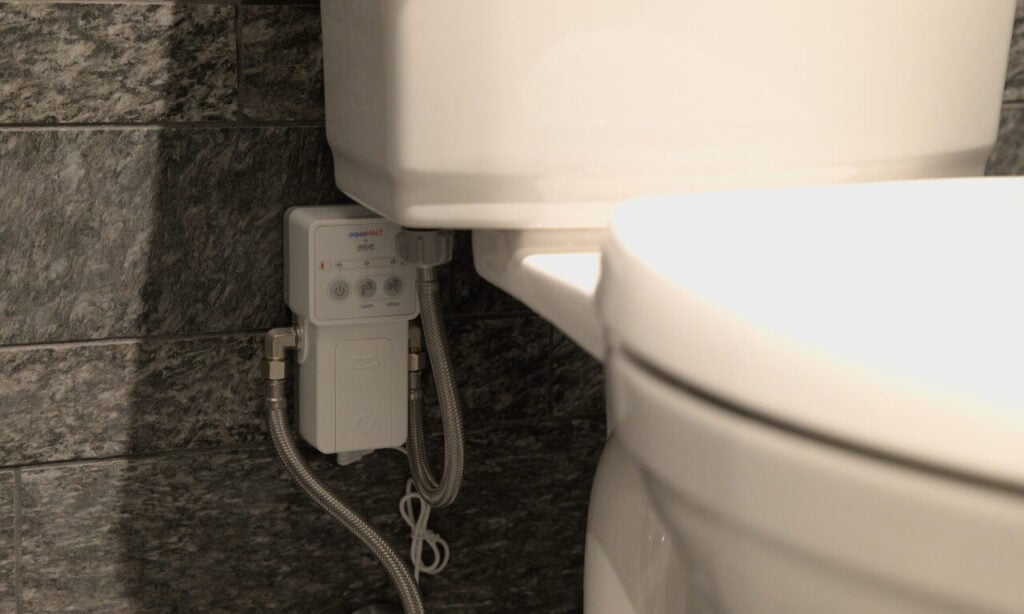
Fit an automatic shut-off such as the aquaHALT 2X. It does not measure water use. It shuts off the toilet’s supply line when its floor sensor gets wet and beeps so you hear it. A slow leak inside the tank never reaches the floor, so use the food coloring test above for that.
Step 3: Fix the Root Cause
Once you confirm the leak, here’s how to tackle the common culprits:
1. Replace the Flapper
This is the rubber seal at the bottom of the tank.
- Shut off the water supply.
- Flush the toilet to empty the tank.
- Remove the old flapper and replace it with a universal one (under $10 at any hardware store).
- Turn water back on, test.
2. Adjust or Replace the Fill Valve
If the humming continues after replacing the flapper, the fill valve may be the issue.
- Turn off the water supply.
- Remove the old fill valve (unscrew from the bottom of the tank).
- Install a new, quiet-fill valve (Fluidmaster makes good ones).
- Adjust the float height so the tank stops filling about 1 inch below the overflow tube.
3. Check Water Pressure
Sometimes, excessive water pressure (above 80 psi) can cause the fill valve to vibrate.
- Use a pressure gauge on an outdoor spigot to test it.
- If it’s too high, consider installing a pressure-reducing valve for your home.
These quick steps will help stop toilet noise at its source, without needing a plumber for most situations.
Step 4: Test and Monitor
Once repairs are done, test the system:
- Re-run the food coloring test.
- Listen for humming over the next few hours.
If the hum comes back
Run the food coloring test again. If color shows up in the bowl, replace the flapper first, since it’s the most likely cause and the simplest fix. Still humming after that? Look at the fill valve, then your water pressure. If you can’t track it down, a plumber can check both in one visit.