
A whole-house automatic water shut-off valve sits on the main line and can close the water to everything after it. It usually needs a plumber and a power supply, and on its own it cannot sense a leak that does not draw water through the main. A shut-off at one fixture protects only that toilet, sink or ice maker, but it fits on the fixture’s own supply and can run on batteries. If you control the main, the whole-house valve covers more; renters, building residents and anyone worried about a few fixtures should start at the fixture.
Settle what you need covered before you look at any product. The comparison below follows the EPA’s WaterSense guide to leak detection devices, which splits them into point-of-entry devices on the main and point-of-use devices at the fixture.
It watches the water coming into the house. The EPA’s WaterSense guide to leak detection devices describes these point-of-entry devices as sitting on the main water line, at the meter or where the water enters the building. They track flow or pressure for the whole home. The in-line kind usually includes its own shut-off valve.
What counts as a leak is partly up to you. The EPA’s guide says owners can often program these devices to raise an alert when water has run continuously for a set time, or when a set volume has passed. Some also allow for irrigation schedules, seasons and planned vacancies.
That setting is a trade-off. Set it loose and more water escapes before the device reacts. Set it tight and a long shower or a filling bathtub can look like a leak. Ask how a device tells the two apart.
Some systems also place moisture sensors around the house and let them close the main valve. The EPA calls that a hybrid system.
One fixture, and you know where the problem is the moment it trips. A point-of-use device sits at a single fixture, such as a toilet, sink or ice maker. One design pairs a valve on that fixture’s supply with a sensor on the floor. If water reaches the sensor, the valve closes, and every other faucet and toilet in the house keeps working.
Because it watches one spot, it needs no setting for how much water your household uses. It reacts to water on the floor, whichever pipe the water came from.
Both have blind spots, and they fall in different places.
A whole-house valve watches flow, not floors. The EPA’s guide says these devices cannot identify leaks that are not tied to water use. Its examples are condensate from an air conditioner, a roof leak and a drain pipe dripping under a sink. When one does raise the alarm, it does not say where the water is.
A fixture shut-off sees only its own patch of floor. A leak at the wall’s stop valve, or in the hose running from it to the device, is out of its reach. It knows nothing about fixtures that do not have one. A pipe leaking inside a wall or under a slab never reaches its sensor, and neither does water that runs the other way.
The table follows the EPA guide’s summary of device types. Products vary, so check each one’s own documentation.
| Whole-house valve on the main | Shut-off at one fixture | |
|---|---|---|
| Where it goes | The main line, at the meter or where water enters | The supply to one toilet, sink or ice maker |
| What it closes | Water to everything after it | Water to that fixture only |
| How it spots a leak | Flow or pressure that looks wrong, sometimes with moisture sensors added | Water at its sensor, or flow at that fixture, depending on the device |
| What it misses | Leaks not tied to water use, such as a drain or condensate | Leaks upstream of its valve, and every fixture without one |
| Where the leak is | The alert does not say | At that fixture |
| Who installs it | Usually a plumber | Can be the owner |
| Power | Usually household electricity, sometimes with battery backup | Usually batteries |
| How you hear about it | Phone or email alerts over Wi-Fi | An alarm at the device, or a phone or email alert on some models |
Plan on a plumber for the whole-house valve. The EPA’s guide says installing an in-line, point-of-entry device will likely mean hiring one. A device that runs on electricity also needs a power source nearby. If your main comes in through a crawl space with no outlet near it, getting power to the valve becomes a job of its own.
The guide adds two questions for any installer. Will the valve suit the size of your pipe? And could it interfere with, or shut off, the water to a home fire sprinkler system?
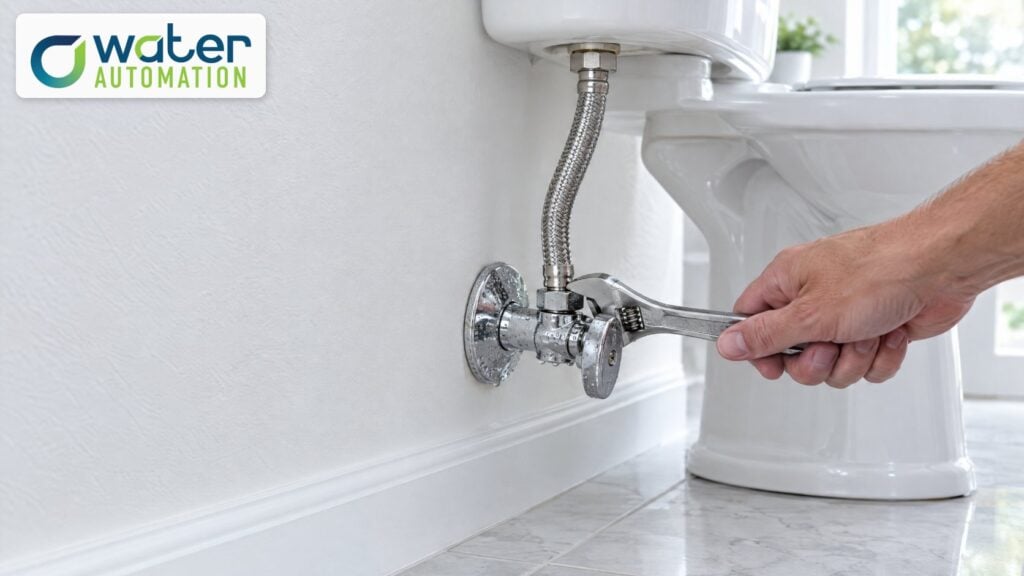
A fixture shut-off leaves the main alone. It goes on the short supply hose between the fixture’s stop valve and the fixture, which puts it within reach of an owner with a wrench. The catch is that stop valve. You close it to undo the hose, so a stop that still lets water through has to be replaced first, and that part is a plumber’s job.
A battery-powered device keeps working through a power outage, while a valve that runs on household electricity needs a battery backup to do the same. The EPA points out that the weather behind some leaks can also cut the power. Its advice is to choose battery power or a backup if the device has to keep working through an outage.
The same guide says whole-house devices typically need external power and send their alerts over Wi-Fi. Ask what the valve does when the power fails, and what becomes of its alerts when the router is down.
A battery-powered fixture shut-off with only a local alarm needs neither an outlet nor a network. The trade is how you hear about it. A device with no radio can only sound an alarm where it sits, so nobody hears it in an empty house, although the water at that fixture is already off. If that trade decides it for you, battery-powered leak detectors compared with smart home systems covers it in more detail.
A whole-house valve suits a house you own, where you control the main, there is power nearby and the Wi-Fi reaches. The EPA notes that point-of-entry devices cover outdoor water use as well as indoor, and that many can also watch for freezing pipes. That matters for a house with irrigation, outdoor lines or hard winters.
Fixture shut-offs suit places where the main is not yours to close. Say you rent a one-bedroom on the fourth floor of an older walk-up. The valve where water enters the building feeds every apartment, so a device there would shut off the whole building. A shut-off on your own toilet or ice maker line stays inside your unit, and it is a change to clear with your landlord first.
Property managers and condo boards run into the same problem across many units. They can add protection fixture by fixture, for example when a rental unit turns over, without touching shared risers. Automatic shut-off valves for apartment buildings covers that side in more depth.
Second homes can go either way. The EPA’s guide suggests shut-off capability for a vacation home without regular occupancy, and both types offer it. Nothing stops you combining them, with a valve on the main for the pipes you cannot see and fixture shut-offs where you worry most.
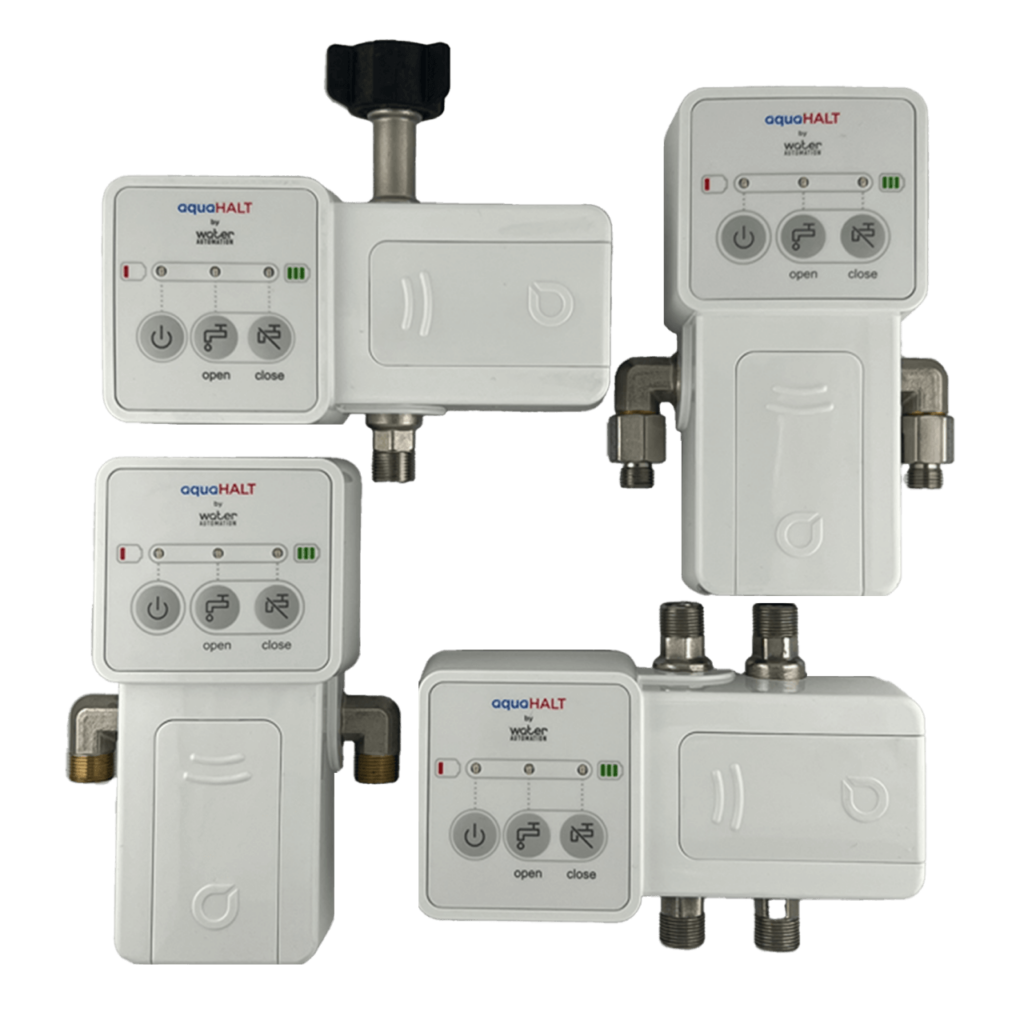
aquaHALT sits on the fixture side. Its manuals describe a valve on one fixture’s supply hose, with a wired sensor that has to touch the floor. water AUTOMATION’s buy now page puts the job plainly: the internal valve shuts off the supply at the toilet, sink or ice maker. Toilets are covered by the aquaHALT 2X and the aquaHALT Flip, sinks by the H/C and ice maker lines by the ICE.
The same page says its two AA batteries remove the need for an electrician, and the homepage says it needs no Wi-Fi, app or subscription. The tools named in the manuals are an adjustable wrench and a level, both small. The 2X installation manual starts with the stop valve check described above: if the wall valve next to the toilet still lets water through, it tells you to call a plumber for a new one.
aquaHALT does not go on the main or watch your household’s flow, so it will not catch a pipe leaking inside a wall. One device covers one fixture, so a home with two toilets and an ice maker needs three. When a toilet or ice maker model trips, it beeps where it is mounted, and nothing is sent to your phone.
For buildings, the product pages invite bulk order inquiries, and the partner page has sections for property managers, plumbers and builders. The manuals and install videos for the 2X, Flip and ICE are collected on the aquaHALT installation page.
Before you spend anything:
Once you have chosen, write down what your setup cannot see, so nobody in the house assumes those spots are protected. If the toilets top your list, start with the aquaHALT 2X and its manual.