

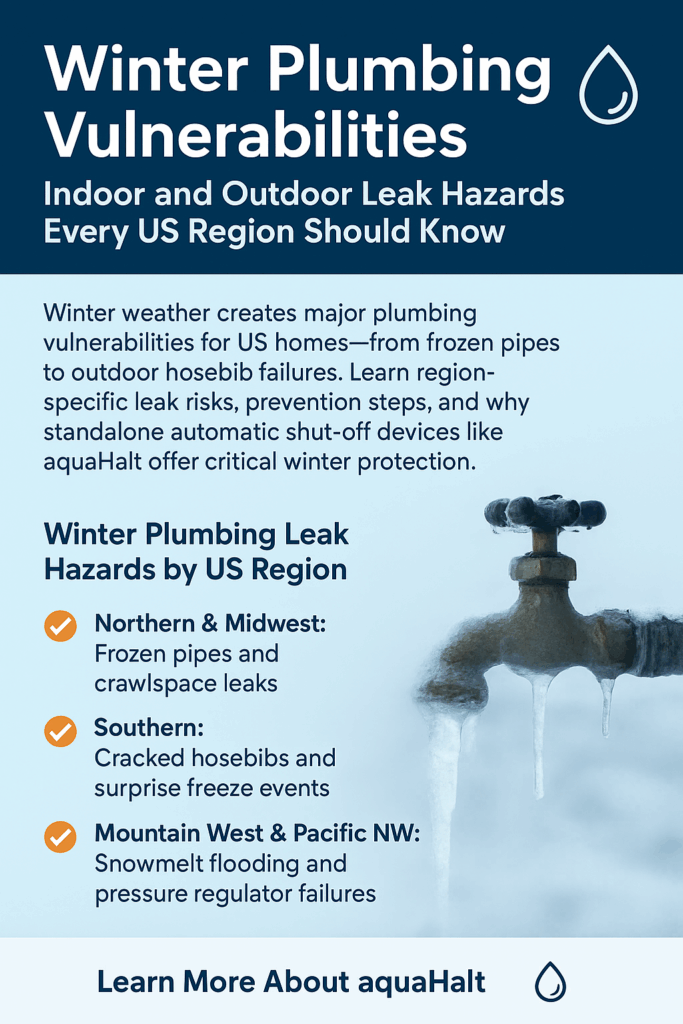
As temperatures drop, plumbing systems across the country come under stress in ways most homeowners never notice until a leak becomes a flood.
Water damage and freezing caused 22.6% of homeowners insurance losses in 2023, and the average claim for them was $15,400 from 2019 to 2023 (Insurance Information Institute).
The challenge is that many winter-related leaks are:
Slow and silent
Hidden behind walls, outdoors, or in crawlspaces
Completely preventable with the right preparation
From frozen interior pipes up north to split hosebibs in warmer states, winter reveals vulnerabilities that otherwise stay dormant all year.
Winter doesn’t strike every region the same way. Here’s what homeowners across the country should prepare for.
Typical states: MN, WI, MI, IL, OH, PA, NY, VT, ND, SD, MA, ME
Extended freezes and sudden temperature drops make these areas especially vulnerable to:
High-risk locations include:
Uninsulated basements
Exterior-facing walls
Garages
Attics
When water freezes, it expands, and the pressure can rupture copper, PEX, and PVC lines.
In winter, furnace-attached humidifiers often drip due to:
Cracked valves
Loose fittings
Clogged drain tubes
These leaks often go unnoticed for weeks.
Add insulation sleeves to exposed pipes
Leave cabinet doors open during severe cold snaps
Disconnect and drain humidifier lines during maintenance
Put an aquaHALT on each sink, toilet and ice maker line for automatic shutoff protection
Where aquaHALT fits here:
aquaHALT won’t catch a pipe that bursts in a crawlspace, a basement or inside a wall: it guards one toilet, sink or ice maker line and reacts when water reaches its floor sensor. At that fixture, it shuts off the water by itself, even in a power or internet outage, with no Wi-Fi, no wall outlet and no app needed. For burst pipes, insulation and a whole-home shut-off on the main line are the tools to use.
Typical states: TX, LA, GA, SC, AL, MS, OK, AZ
Southern homes are built for heat, not cold. That’s why unexpected freezes, such as the Texas 2021 event, cause massive water damage.
Common vulnerabilities:
Non-insulated hosebibs
Exposed PVC irrigation lines
Outdoor laundry hookups
A single overnight freeze can split a spigot or crack a line behind the wall.
Many homes place water heaters, softeners, or washing machines in outdoor closets, which makes them highly vulnerable.
Install hosebib covers
Insulate outdoor utility closets
Drain irrigation systems
Check the washing machine hoses in exterior laundry closets before a freeze
Where aquaHALT fits here:
Outdoor utility closets can freeze before indoor rooms do, so insulate them and drain what you can. Inside, an aquaHALT on each toilet, sink and ice maker line shuts off that fixture’s water if a leak reaches its sensor while you’re away.
Typical states: CO, UT, WY, ID, WA, OR, MT
This region’s temperature swings between freezing nights and warmer days create constant plumbing stress.
Water in exposed pipes can freeze at night and thaw during the day, a cycle that weakens plumbing over time.
Cold snaps can crack regulator valves, triggering:
Leaks at the main
Appliance hose bursts
Sudden surges in pressure
Basements and crawlspaces often take on water during late-winter melts.
Insulate all exterior piping
Test pressure regulators annually
Keep sump pumps clear
Add aquaHALT units to sinks, toilets and the ice maker line
Even homes in warm climates experience winter-related plumbing issues:
Cold weather stiffens supply lines, increasing the chance of cracks.
Small drips go unnoticed more easily during winter months.
Winter strain increases the risk of tank failure and valve leaks.
Drain tubes work harder in winter and clog more often.
Prevention:
Install aquaHALT units on the fixtures it’s made for: toilets, kitchen and bathroom sinks, and the ice maker line. Laundry rooms and water heaters need a different kind of protection, such as a leak alarm.
These should be checked immediately:
Outdoor hosebibs
Irrigation/sprinkler systems
Pool equipment
Exterior laundry hookups
Water softener sheds
RV/auxiliary connections
Even a minor winter leak can freeze, expand, and rupture, causing severe structural damage.
Kitchen sinks
Bathroom sinks
Behind toilets
Laundry machines
Water heaters
Furnace humidifiers
Hosebibs
Exterior utility closets
Crawlspace entry points
Softener sheds
Where aquaHALT fits in winter:
If the internet drops or the power goes out, aquaHALT keeps working on the toilets, sinks and ice maker line it guards, shutting off that fixture’s water when water reaches its sensor; the toilet and ice maker models beep as well.
Winter plumbing failures are expensive, disruptive, and often invisible until the damage is extensive. But with the right preparation and the right protection, they’re far easier to prevent than repair.
Insulate exposed pipes
Cover and drain hosebibs
Inspect appliance supply lines
Check furnace humidifier tubing
Install automatic shutoff devices like aquaHALT
If you want a leak protection system that works even during:
✔ Power outages
✔ Internet outages
✔ Router failures
Then aquaHALT is built for it: standalone and automatic, on two AA batteries, with a shut-off for each toilet, sink and ice maker line.